Published: 10 November 2026Last reviewed: 10 November 202614 min read
Would you rather rent than buy?Use our aerial platform rental directory: 87 companies across Portugal, with a map, a filter by machine type and indicative prices.See rental companiesIn short: gradeability is the limit for travelling the machine in the stowed (transport) position, usually given as a percentage. The maximum working slope — tilt alarm or tilt cut-out, max tilt rating or maximum operating slope — is the limit once the elevating structure is raised, almost always in degrees and much lower. A rough-terrain scissor with 40% gradeability is not approved to work on a 40% slope: on the EMEA sheets for the ERT2669 and the ERT3369 that working limit is 2.5° side-to-side and 3° fore and aft. Always check the data plate and the manual of the unit you will use.
On a construction site the ground is rarely a level concrete slab: there are slopes, backfill, wet grass, kerbs, holes and recently compacted areas. The temptation is to read “45% gradeability” on the specification sheet and conclude that the machine “can climb anything” and can work on that slope. It cannot. This guide explains the difference between gradeability and working slope, what tilt sensors, 4WD, oscillating axles and levelling jacks do, what to check on the ground — including floor loading and ground bearing pressure and wind — and how to choose between a slab machine, a rough-terrain machine and a crawler boom.
Gradeability and working slope are not the same thing
In its Ground Conditions and Supporting Structures guidance, IPAF defines gradeability as the maximum angle a MEWP can drive up or down a slope in the stowed/transport position. The figure is in the operator’s manual and, on JLG specification sheets, is usually given as a percentage. It is a travel limit, with the scissor or boom lowered, and it depends on the ground and on traction: IPAF notes that if the ground is poor, you should not attempt to drive up, down or across the slope.
The maximum working slope is a different quantity. It is the most the chassis may be inclined once the elevating structure leaves the stowed position — on scissors and boom lifts, the max tilt rating or the tilt alarm; on X-series crawler booms, the maximum operating slope, with the outriggers set. This limit is typically only a few degrees. Confusing it with gradeability is the most common, and the most serious, misreading of a specification sheet.
The relationship between the two scales is trigonometric: grade in percent is tan(θ) × 100, where θ is the angle in degrees. 45% is about 24.2°; 2.5° is about 4.4%. A machine can therefore have 45% gradeability and a 4° tilt alarm — as the 600AJ does on the 2025 EMEA sheet — without any contradiction: one figure is for travelling stowed, the other is for working elevated.
| Grade | Approximate angle | Angle | Approximate grade |
|---|---|---|---|
| 25% | 14.0° | 1.5° | 2.6% |
| 28.7% | 16.0° | 1.75° | 3.1% |
| 30% | 16.7° | 2.5° | 4.4% |
| 35% | 19.3° | 3° | 5.2% |
| 40% | 21.8° | 4° | 7.0% |
| 45% | 24.2° | 5° | 8.7% |
| — | — | 12° | 21.3% |
Tilt sensors, tilt alarms and drive cut-out when elevated
Chassis inclination is measured by the machine’s tilt sensor, in the longitudinal and transverse axes (X and Y), as IPAF describes. When the allowable limit is reached, an audible alarm or a light warns the operator. On many MEWPs the system also prevents drive and elevating functions, leaving only the movements needed to return to the safe range. JLG describes its tilt-sensing logic in the same terms: an alarm and a disable of boom and drive beyond the rated slope, with restricted functions to return within the permitted range.
IPAF is clear about elevated travel: mobile verticals and mobile booms can travel with the structure out of the stowed position, but this should be done only on a firm, level surface. Once the structure leaves the stowed position, travel speed is automatically reduced (elevated drive speed). Travelling elevated over uneven ground increases the risk of overturning, of the catapult effect (on boom machines, if occupants are not wearing fall-protection PPE) and of impact or entrapment against overhead structures.
On the ERT2669 and ERT3369 electric rough-terrain scissors, the EMEA sheets allow travel up to full height, at an elevated speed of 0.8 km/h (against 5.6 km/h lowered). That does not authorise travelling elevated on a slope or on uneven ground: the working tilt limit (2.5° / 3°) and the requirement for firm, level ground still apply. The same principle holds for boom lifts: 45% gradeability is for the machine stowed.
Alarm and cut-out figures are not the same on every model, nor in every edition of the same sheet. On the 600AJ, the June 2025 EMEA sheet lists a 4° tilt alarm. On the 450AJ, the 2015 and 2016 EMEA sheets and current ANSI sheets list 5° (on the ANSI sheets, a 5° tilt cut out); the 2020 EMEA sheet (Stage V) lists a 4° tilt alarm. We do not reconcile these figures: what counts is the data plate and the manual of the unit on site. Limits may also differ between ANSI and CE versions, and between driving up, down or across a slope, as IPAF notes.
Some JLG rough-terrain scissors have QuikLevel Advanced, which, according to JLG, automatically levels the machine on side slopes of up to 4.5° and, in certain conditions, allows travel at full height. That is not the same as the 2.5° maximum tilt published on the ERT/RT series sheets, and it is not fitted on every machine. There is also LiftSense, which can limit height according to chassis tilt and platform load. Treat these functions as model-specific and confirm them in the manual.
4WD and 2WD, oscillating axles and differential lock
IPAF groups, among rough-terrain MEWPs, the features designed for travelling stowed over uneven ground: four-wheel drive (4WD), oscillating axles, differential lock and, on crawler booms, tracks. Each does something different, and none of them replaces the working-slope limit.
- 4WD and 2WD. Four-wheel drive supplies torque to all four wheels; some machines can switch between 4WD and 2WD. This changes gradeability, not the working-slope limit. On the 600AJ EMEA sheet, gradeability is 30% in 2WD and 45% in 4WD. On the 450AJ EMEA sheets the published figure is 45% (the 2020 sheet specifies 45% in 4WD); the 450AJ ANSI sheets distinguish 30% in 2WD and 45% in 4WD. On the electric ERT scissors, the EMEA sheets specify 2WD AC drive; on the engine-powered RT series, the 2025 JLG sales manual specifies 4WD hydrostatic drive.
- Oscillating axle. This keeps the wheels in contact with the ground, within the oscillation travel, when the surface is not flat. IPAF distinguishes two types: an active axle, which moves in a controlled way and, according to IPAF’s note, helps keep the machine stable also with the structure raised; and a passive axle, which moves freely only in a defined configuration (usually stowed or only slightly raised) and locks at that angle once the structure leaves that configuration. On the EMEA sheets, the 450AJ has an oscillating axle with 10 cm of travel and the 600AJ has an oscillating front axle with 0.20 m; the ERT scissors include an oscillating front axle as standard. An oscillating axle does not increase the maximum working slope: it stops a wheel lifting off the ground when travelling stowed.
- Differential lock. IPAF describes this as a device for driving through soft ground (for example sand): it can lock the drive axle so that both wheels turn at the same speed. It helps traction when travelling, not when working elevated on a slope.
- Self-levelling chassis. IPAF describes this as a distinct sub-system that allows some boom lifts to level automatically on grades of up to about 10°. It is not the oscillating axle of a 450AJ or a 600AJ, and it should not be assumed on a machine that does not list it in the manual.
Tyres, ground clearance and levelling jacks
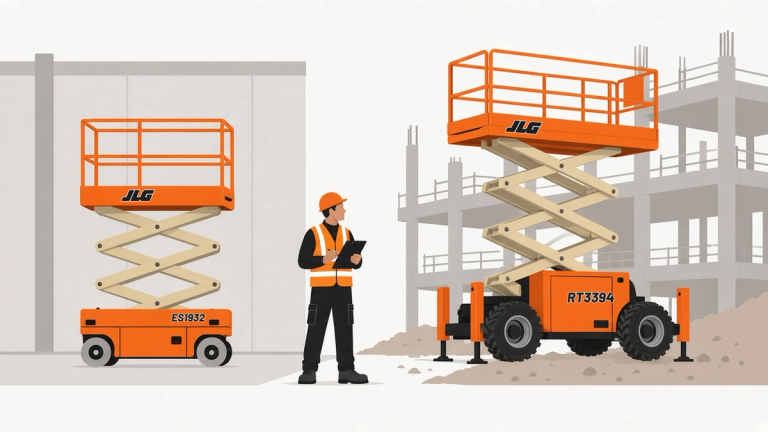
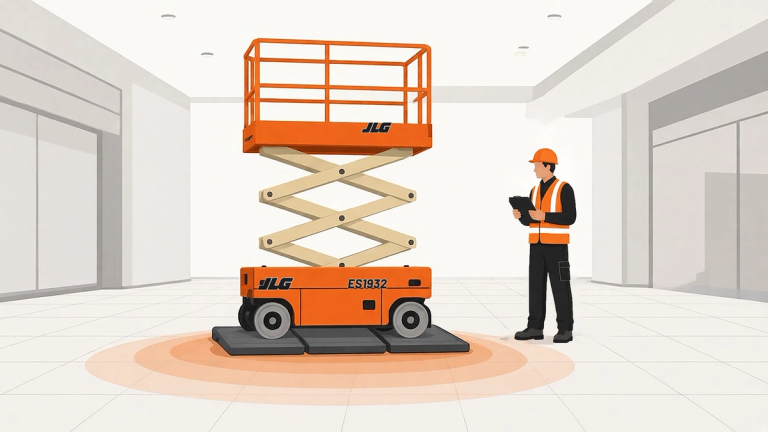
The choice between a slab machine and a rough-terrain machine is also visible in the tyres and in ground clearance. Indoor electric scissors such as the ES1932 and the ES2632 use non-marking solid tyres and have low ground clearance: 7 cm on the ES1932 and 98 mm on the ES2632, according to the EMEA sheets. The ERT scissors use 26 × 12 foam-filled tyres (with a non-marking option in the series brochure) and have about 25.6 cm of ground clearance at the centre of the machine — enough to clear irregularities that a slab scissor would not, but not enough to ignore trenches, kerbs or holes.
On the boom lifts, the 450AJ EMEA sheet gives 0.42 m of ground clearance and superwide foam-filled tyres (with a non-marking option); the 600AJ sheet gives 0.30 m and foam-filled IN 355/55 D625 tyres, also with a non-marking option. Rough-terrain tyres improve grip and the ability to cross uneven ground; non-marking tyres protect finished floors. Neither increases the maximum working slope, and ground bearing pressure changes with the type of tyre — a subject we cover in the guide to floor loading and ground bearing pressure.
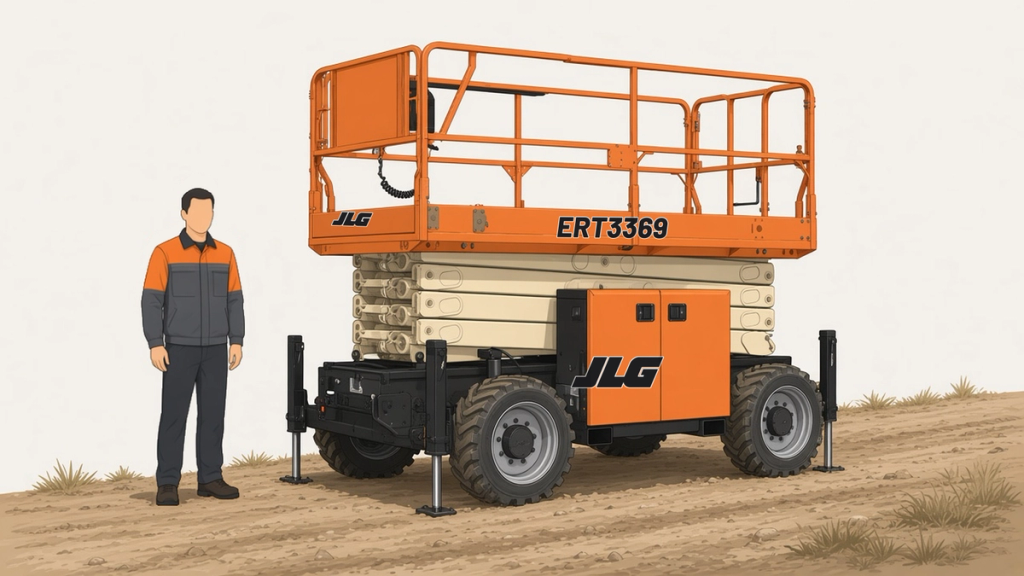
On ERT and RT scissors, the EMEA model sheets and the series brochure list hydraulic levelling jacks (hydraulic leveling jacks, with auto-level in the series brochure). They are there to level the chassis before raising the platform, not to work or travel elevated beyond the tilt limit. They should be used only as the manual describes, with the chassis within the intended window and with the ground able to take the load at the pads. On the X17JP and X20JP crawler booms, the equivalent role is played by the auto-levelling outriggers: the published maximum operating slope is 12°, with the machine set up on the outriggers; the 28.7% gradeability (16° on the X20JP sheet) is the travel limit on the tracks, in the stowed position.
What to check on the ground, not only on the specification sheet
Before travelling or raising the machine, IPAF recommends assessing whether the ground is safe to drive and to work on. Unsuitable ground can cause the machine to slip or overturn, even if the published gradeability looks generous. Walk the route and the work position and check, in particular:
- Soft, wet or recently backfilled ground. Traction and bearing capacity fall; IPAF notes that water at the surface or poorly compacted backfill can make the support unstable. Gradeability assumes adequate traction.
- Holes, trenches, covers, kerbs and drop-offs. These are obstacles for ground clearance and points where a wheel can lose contact or the machine can tip. Do not travel or raise the platform next to the edge of a slope, a trench or a kerb.
- Side slopes and the direction of travel. IPAF notes that limits may differ for driving up, down or across a slope, and between 2WD and 4WD. Measure the slope — with an inclinometer, or from rise over run, as IPAF illustrates — and compare it with the right figure: gradeability if you will travel stowed; working slope if you will raise the structure.
- Ground bearing capacity and floor loading. Being able to drive across an area does not mean that area can support the machine in work: travel loads and working loads are not the same, and pressure spreads down and outwards in a fan. See the guide to floor loading and ground bearing pressure. Trapézio de Prismas does not carry out structural calculations or assessments of ground bearing capacity; that judgement sits with whoever is planning the work and, where required, with an engineer.
- Wind, outdoors. On outdoor platforms, the wind rating on the data plate applies at the same time as the tilt limit. Treat the two together: wind and aerial work platforms.
How to choose between a slab machine, a rough-terrain machine and a crawler boom
The decision is not simply “which machine can climb more”. It is the combination of route, work position, ground, slope and height. The examples below are figures published by JLG; they do not replace the specification sheet, data plate and manual of the unit you will use. Options, country standards (ANSI or CE) and the year of manufacture can change the figures.
| Machine | Type | Gradeability | Working slope | Drive and chassis | Ground clearance |
|---|---|---|---|---|---|
| JLG ES1932 | Electric slab scissor | 25% | Side-to-side: 1.75° (indoor) / 1.5° (outdoor); fore and aft: 3.75° | Compact indoor scissor | 7 cm |
| JLG ES2632 | Electric slab scissor | 25% (14°) | Side-to-side: 1.5°; fore and aft: 3.5° | Front-wheel drive and steer | 98 mm |
| JLG ERT2669 | Electric rough-terrain scissor | 40% | Side-to-side: 2.5°; fore and aft: 3° | 2WD AC, oscillating front axle | 25.6 cm |
| JLG ERT3369 | Electric rough-terrain scissor | 40% on the model EMEA sheet; 35% in the 2026 EMEA series brochure and the 2025 sales manual | Side-to-side: 2.5°; fore and aft: 3° | 2WD AC, oscillating front axle | 25.6 cm |
| JLG RT2669 / RT3369 | Engine-powered rough-terrain scissor | 40% (RT2669) and 35% (RT3369) in the 2025 sales manual | Side-to-side: 2.5°; fore and aft: 3° (2025 sales manual) | 4WD hydrostatic (2025 sales manual) | — |
| JLG 450AJ | Articulating boom | 45% on the EMEA sheets (2020: 4WD 45%); 30% / 45% (2WD / 4WD) on the ANSI sheets | 5° alarm on the 2015/2016 EMEA sheets and on ANSI sheets; 4° alarm on the 2020 EMEA sheet. ANSI tilt cut out: 5° | 4WD hydrostatic, oscillating axle 10 cm | 0.42 m |
| JLG 600AJ | Articulating boom | 30% (2WD) / 45% (4WD) | 4° tilt alarm (2025 EMEA sheet) | Oscillating front axle 0.20 m | 0.30 m |
| JLG X17JP | Crawler boom | 28.7% | Maximum operating slope 12° | Tracks and auto-levelling outriggers | — |
| JLG X20JP | Crawler boom | 28.7% (16°) | Maximum operating slope 12° | Tracks and auto-levelling outriggers | — |
In practice: a slab scissor (ES series) is the usual choice indoors, with non-marking tyres and good manoeuvrability, but with low ground clearance and a very tight working tilt (about 1.5° side-to-side). A rough-terrain scissor (electric ERT or engine-powered RT) gains ground clearance, wide tyres, an oscillating axle and, where fitted, levelling jacks; gradeability rises to around 35% to 40%, but the working tilt remains close to 2.5° / 3°. An articulating boom such as the 450AJ or the 600AJ adds outreach, 4WD and a tilt alarm typically of 4° or 5° — still far from the 24° equivalent of 45% gradeability. An X-series crawler boom is the option when you need tracks, to pass through narrow openings and to work set up on slopes of up to 12°, with the ground assessed. For the wider picture, see types of aerial work platforms, how to choose a JLG scissor and when to use a crawler boom.
Practical checklist before travelling or raising on uneven ground
- Identify the type of ground on the route and at the work position (firm and level, sloping, backfill, grass, soft or wet ground, kerbs and drop-offs).
- Read, on the unit’s data plate and manual, the gradeability and the maximum working slope (tilt alarm or cut-out), and whether the figures differ for driving up, down or across a slope, or between 2WD and 4WD.
- Measure the slope on the route and at the work position and compare it with the right figure: gradeability only for stowed travel; working slope for raising the structure.
- Do not treat gradeability as the working limit with the scissor or boom raised.
- Travel elevated only on firm, level ground, at the reduced speed the machine imposes.
- Check for holes, trenches, covers, kerbs, edges of slopes and areas of backfill or standing water; do not travel or raise the platform next to drop-offs.
- Confirm ground clearance, tyre type, the condition of the oscillating axle and, if the machine has them, the correct use of levelling jacks or outriggers, according to the manual.
- Take account of ground bearing pressure and, outdoors, the wind rating on the data plate, at the same time as tilt.
- If the slope, the ground or the bearing capacity has not been confirmed, do not proceed: change machine, change position, or obtain the view of whoever is responsible for the ground.
Need help choosing the right machine?
We are the official JLG dealer in Portugal. We can help you choose a platform that suits the route and the work position — slab scissor, rough-terrain scissor, articulating boom or crawler boom — whether you are looking at new JLG machines or aerial work platform rental. You can consult the JLG manuals to confirm the gradeability and working slope of your machine. We do not carry out structural calculations or assessments of ground bearing capacity; that judgement sits with whoever is planning the work and, where required, with an engineer.
If you would like help choosing a machine or a technical inspection, get in touch. On site, the electric scissor lift checklist remains the starting point before going up.
Sources and legislation
- IPAF — Ground Conditions and Supporting Structures (TE-2003-0225-1-en)
- IPAF — Spread the load! (TR-675-0123-5-en)
- JLG — Ficha técnica ES1932 (EMEA)
- JLG — Ficha técnica ES2632 (EMEA)
- JLG — Ficha técnica ERT2669 (EMEA)
- JLG — Ficha técnica ERT3369 (EMEA)
- JLG — Folheto de série ERT (EMEA)
- JLG — Ficha técnica 450AJ (EMEA, 2016)
- JLG — Ficha técnica 450AJ (EMEA, 2020)
- JLG — Ficha técnica 450AJ (ANSI, 2024)
- JLG — Ficha técnica 600AJ (EMEA, 2025)
- JLG — Ficha técnica X17JP (EMEA)
- JLG — Ficha técnica X20JP (EMEA)
- JLG — Manual de vendas 2025
- JLG — Technologies That Advance Safe Work at Height (tilt sensing)
- JLG — What’s New with JLG Rough Terrain Scissor Lifts (QuikLevel Advanced, LiftSense)
This guide is for information only and does not replace the legislation in force or legal advice. When in doubt, contact the Portuguese labour authority (ACT).
Keep reading
24 October 2026 · 6 min read
JLG scissor lifts: how to choose between an indoor electric scissor and a rough-terrain scissor
JLG ES electric scissor for smooth concrete floors, or ERT/RT rough-terrain scissor for site work? We compare the current models (CE specification) and give you 8 questions to choose right first time.
Read the guide10 November 2026 · 13 min read
Floor loading and ground bearing pressure: industrial floors, slabs and paving
What ground bearing pressure is, how it differs from wheel load, which figures JLG publishes, and what to check on industrial floors, slabs, shopping centres and paving.
Read the guide